Standard Residential Garage-Door Heights and Widths: A Sizing Primer
While the residential garage-door market presents a wide array of dimensions, certain width-and-height combinations have emerged as prevailing norms for typical one-and two-vehicle bays in Indonesia. These “standard” sizes reflect historical vehicle dimensions, national manufacturing roll-stocks, and established track/torsion-spring systems.
Table of Contents
ToggleTypical Sizes
For single-car garage openings:
- Width: ~ 8 ft (≈ 2.44 m), 9 ft (≈ 2.74 m) or 10 ft (≈ 3.05 m)
- Height: ~ 7 ft (≈ 2.13 m) or 8 ft (≈ 2.44 m)
For double-car (side-by-side) openings:
- Width: ~ 16 ft (~ 4.88 m), 18 ft (~ 5.49 m) or 20 ft (~ 6.10 m)
- Height: typically 7 ft or 8 ft
These are starting points, not rigid standards: higher widths and heights exist especially when accommodating oversized vehicles or custom architecture.
Why Proper Door Height Matters: Functional + Design + Technical Considerations
Fit & Functionality
A door that is too short may restrict safe ingress/egress of taller vehicles (SUVs, trucks with roof racks, lowered cars with inverted travel or lifts). Too tall may complicate spring/track geometry, add cost or reduce sealing efficiency.
Curb Appeal & Proportion
From a façade standpoint, a garage-door height that appears out of proportion can disrupt the architectural line of the home or building. For developers targeting premium appearance, ensuring door height aligns with fenestration and roof height is critical.
Energy, Insulation & Sealing
An undersized or oversized door may compromise perimeter sealing, leading to heat loss or gain. Correct height supports full contact with weather-stripping, maintains insulation performance and protects against drafts.
Operational & Safety Aspects
From an installation perspective, the door height influences spring torsion requirements, track curvature, headroom above opening, and the safe operation envelope (clearance for opener, obstruction zones). An improperly dimensioned door increases risk of failure, pinch-points or spring breakage.
Detailed Measurement Protocols: Beyond Simple Width & Height
Accurate measurement is the foundation of a successful garage-door spec. The process involves more than reading a tape measure across + up.
1. Clear Opening Width
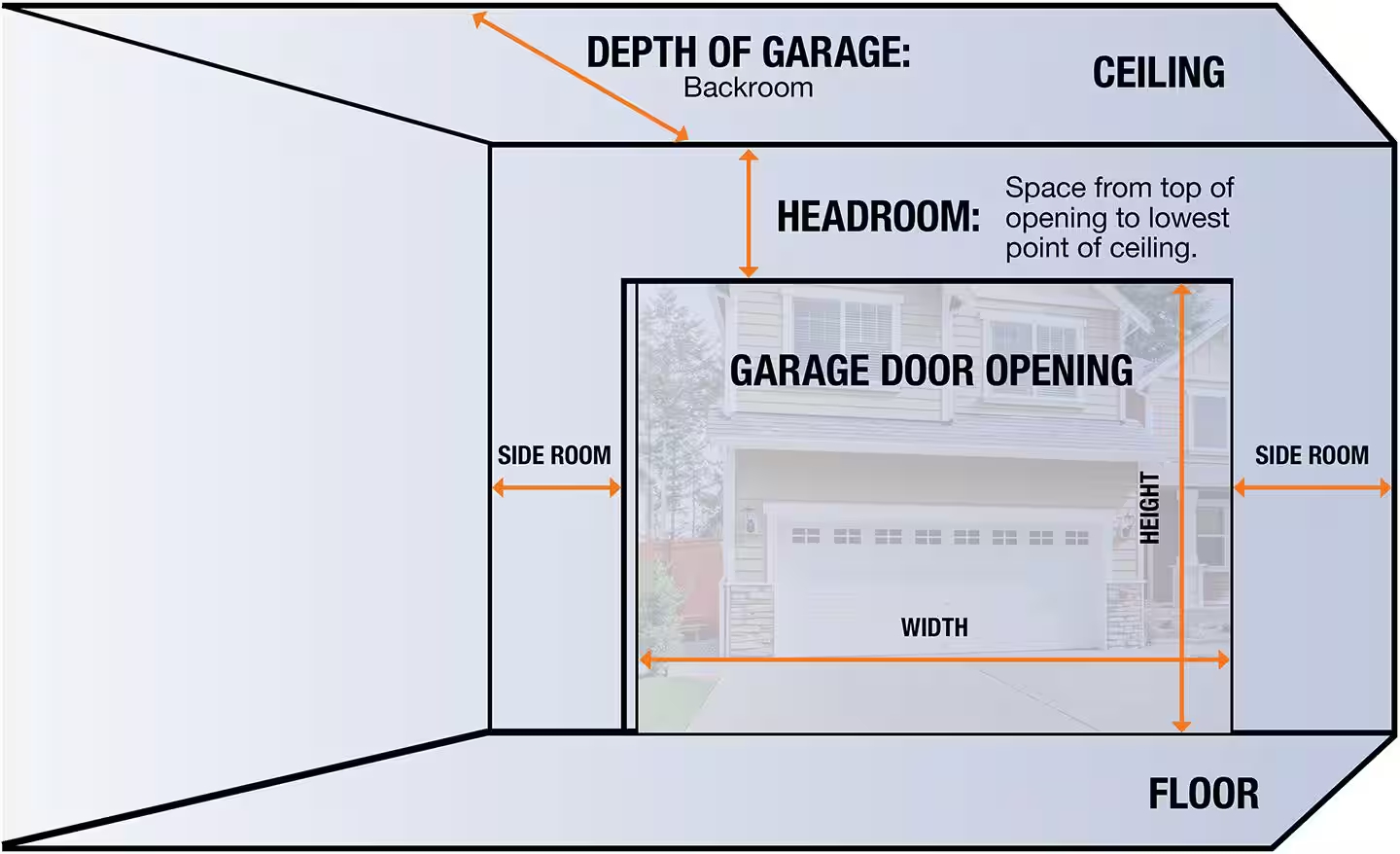
Measure from the inside of the left jamb to the inside of the right jamb at both top and bottom of the opening. Use the smallest width to ensure the door fits without interference.
2. Clear Opening Height
Measure from finished floor to the underside of the header (bottom of the lintel or header beam). Take measurements left, center, right; again use the smallest to ensure clearance.
3. Side Room and Headroom
- Side room = the horizontal clearance from each jamb to the nearest obstruction (wall, column).
- Headroom = the vertical clearance from top of opening to ceiling or lowest obstruction. These determine track/spring system options. For example, standard torsion systems may require ~12 in (≈ 305 mm) headroom; low-headroom tracks are used when clearance is less.
4. Floor Slope & Site Irregularities
Check if the garage floor slopes (common in older builds) as this may affect door height at one end and cause binding. Also account for any header setback, jamb thickness, or insulation/lining behind existing door.
5. Obstructions / Future Use
Note any ceiling-mounted obstructions (light fixtures, ducting) or planned installations (auto lift, rack storage). Also consider future vehicle changes (roof rack, lifted trucks) when selecting height.
Selecting the Right Height for Your Needs: A Forward-Looking Approach
While 7 ft is historically the baseline height, evolving vehicle sizes and homeowner expectations mean opting for 8 ft or more often makes sense.
Standard Passenger Vehicles
If your vehicles are typical sedans or compact SUVs, a 7-ft height alongside 8–9 ft width may suffice. However, as full-size trucks, vans or SUVs become more common, the extra clearance offered by an 8-ft height becomes beneficial.
Oversized Vehicles / Storage Use
If you anticipate storing a lifted truck, a van with roof-top cargo, or mounting storage systems overhead, consider heights of 8 ft or above (9 ft+ custom). Some manufacturers and installers report heights up to 10 ft or more for specialty garages.
Architectural & Market-Positioning Considerations
For premium homes, architectural garages or show-vehicle storage, a higher door gives a more impressive façade, supports larger vehicles, and future-proofs the asset. For developers and manufacturing partners (such as your custom-door factory brand), offering an 8-ft height as “standard upgrade” may differentiate the product in the market.
Manufacturing and Specification Implications for Custom Door Producers
Given your involvement in manufacturing and supplying full-home door systems, there are a few deeper technical and market-relevant implications worth noting.
Inventory & Roll-Stock Strategy
Since 7 ft and 8 ft heights are most common, keeping standard stock frames, springs and hardware optimized for those reduces cost. For non-standard heights (e.g., 9 ft, 10 ft) or widths (18 ft, 20 ft), treat as custom-order lines. This focus supports efficient production planning.
Track & Spring System Impacts
Height choice influences torsion-spring length, cable and drum dimensioning, header requirements, and track radius. For example, a taller door may require heavier-duty springs or larger drums—which should be reflected in your component engineering documentation and installation instructions.
Thermal Performance & Wind Load
As door height increases, the surface area (and hence insulating requirement, structural reinforcement, and wind-load exposure) also increases. For regions with high wind (e.g., coastal or Middle East markets) your door system should be certified (e.g., wind-load tested) for the given height. This is especially relevant given your markets (UAE, Saudi Arabia) where standard dimensions may differ and wind codes apply.
Regional Market Adaptation
While Indonesia standards centre on 7-8 ft heights, in markets like UAE or Middle East there may be different clearance expectations (larger vehicles, higher head-room allowances). Your manufacturing should be capable of offering custom heights (9 ft+) and customizing headroom/track options accordingly. Given your factory and showroom network in Saudi Arabia and UAE, this flexibility is a competitive advantage.
Summary and Specification Checklist
To summarise:- Standard residential garage-door height is typically 7 ft, with many modern installations selecting 8 ft for added clearance.
- Standard widths for single-car are ~8–10 ft; for double-car ~16–20 ft.
- Accurate measurement (width, height, side room, headroom) is essential for fit, function and installation reliability.
- Choosing a door height should balance current vehicle dimensions, future-use expectations, architectural aesthetics, and installation constraints (track/spring system, headroom).
- For manufacturers/suppliers: standardize around 7-8 ft heights, design flexibility for taller/custom heights, account for track/spring/load differences, and align regional customization potential.
Specification Checklist
- Opening width (min) = measure inside jambs, smallest width.
- Opening height (min) = floor to underside of header, use smallest measurement.
- Side room = distance from each jamb to nearest wall or obstruction.
- Headroom = distance from top of opening to ceiling or lowest obstruction.
- Vehicle clearance = ensure door height allows vehicle + roof-rack + vertical lift (if applicable).
- Architectural proportionality = door height aligns visually with façade and roofline.
- Structural specification = for heights >8 ft or widths >20 ft, verify wind-load, spring sizing, track radius, torsion system.
- Region-specific code compliance = especially for high-wind zones (UAE, Saudi Arabia, coasts) or garage-conversion use.
FAQs
1.What are the most common standard sizes for a single garage door?
Typical single garage doors are around 8–9 feet wide and 7 feet high, although some manufacturers also offer 8-foot-high options for taller vehicles or extra storage.
2.How big should a double garage door be for two cars?
A standard double garage door is usually 16 feet wide and 7 feet high, which gives enough room for two regular-sized cars to enter and park comfortably side by side.
3.Can I order a custom garage door size if my opening isn’t standard?
Yes. Most suppliers can make custom garage doors to match non-standard openings in both width and height, but expect a longer lead time and higher price than standard sizes.
4.How much headroom and side room do I need around the garage door opening?
You typically need at least 10–12 inches of headroom above the opening for the tracks and opener, and about 4–6 inches of side room on each side to fit the vertical tracks and hardware.
5.How do I correctly measure my garage opening for a new door?
Measure the width from jamb to jamb and the height from the floor to the underside of the header, then record headroom and side room. Always measure in multiple spots and use the smallest numbers to avoid sizing issues.