Choosing the right kitchen cabinet size is one of the first steps in planning a functional kitchen. If the height, depth, or width is wrong, your countertop, appliances, storage, and workflow can all be affected.
Table of Contents
ToggleThis guide gives you the standard kitchen cabinet sizes for base cabinets, wall cabinets, tall cabinets, pantry cabinets, and island cabinets in both inches and millimeters. You can use it to plan modular kitchen cabinets, custom cabinets, apartment kitchens, or project kitchens with more confidence.
Standard Kitchen Cabinet Sizes Chart
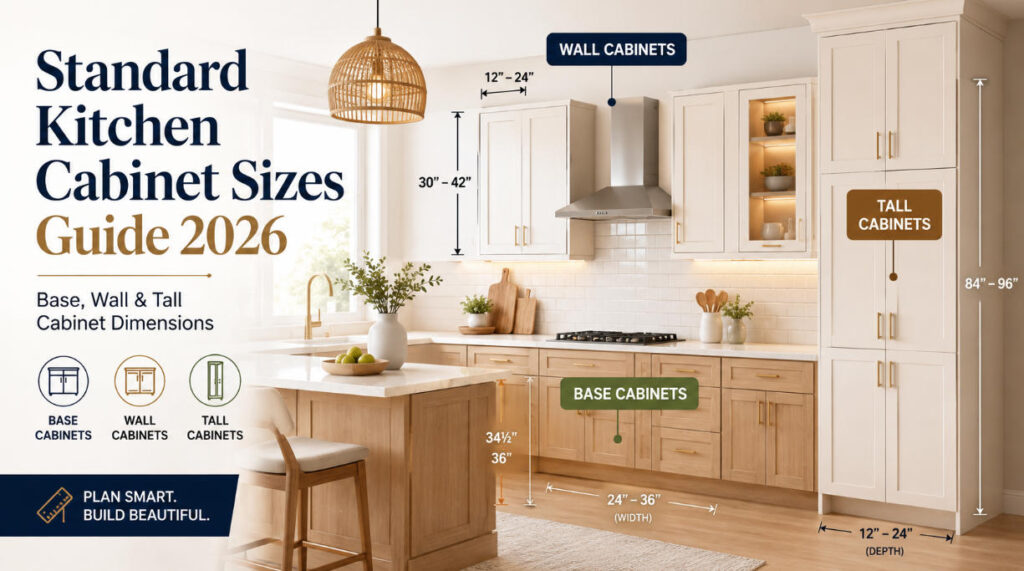
Most standard kitchen cabinet sizes fall into three main groups: base cabinets, wall cabinets, and tall cabinets. Use this chart as a quick reference before reviewing each cabinet type in more detail.
| Cabinet Type | Standard Height | Standard Width | Standard Depth |
|---|---|---|---|
| Base Cabinets | 34.5 in / 876 mm without countertop | 9–48 in / 229–1219 mm | 24 in / 610 mm |
| Wall Cabinets | 12–42 in / 305–1067 mm | 9–48 in / 229–1219 mm | 12 in / 305 mm |
| Tall Cabinets | 84, 90, or 96 in / 2134, 2286, or 2438 mm | 12–36 in / 305–914 mm | 12–24 in / 305–610 mm |
All dimensions are shown in both inches and millimeters. You can use this chart as a starting point, then review the detailed base, wall, and tall cabinet dimensions below.
Cabinet Size Converter: Inches to Millimeters
Use this quick converter to check kitchen cabinet dimensions in both inches and millimeters
Main Kitchen Cabinet Types and Standard Sizes
Kitchen cabinets come in many forms, but most standard cabinet sizes start with three main groups: base cabinets, wall cabinets, and tall cabinets. Understanding these cabinet types makes it easier to compare dimensions and plan the right kitchen layout.
Base Cabinets
Base cabinets sit on the floor and support countertops, sinks, cooktops, drawers, appliances, and lower kitchen storage.
Wall Cabinets
Wall cabinets are mounted above countertops and add upper storage for dishes, cups, dry food, glassware, spices, and daily items.
Tall Cabinets
Tall cabinets maximize vertical storage and are often used for pantry items, built-in appliances, cleaning tools, and utility storage.
Standard Kitchen Base Cabinet Dimensions
Base cabinets are the lower kitchen cabinets installed on the floor. They support countertops, sinks, cooktops, dishwashers, drawers, and everyday kitchen storage.
In most kitchen layouts, base cabinets are planned first. Once the base cabinet height, width, and depth are confirmed, it becomes easier to arrange wall cabinets, tall cabinets, appliances, and kitchen islands.
1. Standard Base Cabinet Sizes

| Dimension | Standard Size | Best Application |
|---|---|---|
| Height | 34.5 in / 876 mm without countertop | Creates a finished countertop height of about 35–36 in / 889–914 mm. |
| Width | 9–48 in / 229–1219 mm | Narrow units suit spice pull-outs and tray storage. Wider units work for drawers, cooktops, trash pull-outs, and cookware. |
| Depth | 24 in / 610 mm | Provides lower storage while keeping items within reach. |
| Finished Depth | 25–26 in / 635–660 mm with countertop overhang | Allows for a standard countertop front edge and a more finished look. |
| Toe Kick | 4.5 in / 114 mm | Helps users stand closer to the countertop comfortably during cooking and prep. |
2. Kitchen Sink Base Cabinet Sizes
Sink base cabinets are designed to hold the sink bowl, plumbing, faucet connections, water filters, garbage disposals, and under-sink storage. They usually need more open interior space than standard storage cabinets.
| Dimension | Standard Size | Best Application |
|---|---|---|
| Height | 34.5 in / 876 mm without countertop | Aligns with surrounding base cabinets and supports a regular countertop height. |
| Width | 30, 33, or 36 in / 762, 838, or 914 mm | 30-inch cabinets suit compact sinks. 33-inch cabinets fit many standard sinks. 36-inch cabinets give more room for larger sinks, plumbing, filters, and waste systems. |
| Depth | 24 in / 610 mm | Provides enough space for plumbing while keeping the sink area accessible. |
3. Drawer Base Cabinet Sizes
Drawer base cabinets are designed for easy-access lower kitchen storage. They work well for cookware, utensils, plates, bowls, food containers, and daily kitchen tools.
- Height: Most drawer base cabinets follow the standard base cabinet height of 34.5 in / 876 mm without the countertop. This keeps them aligned with surrounding lower cabinets.
- Depth: The standard drawer base cabinet depth is usually 24 in / 610 mm. This depth provides useful storage while keeping items within reach.
- Width: Drawer base cabinet width has the biggest impact on storage. Narrow drawers are better for small tools, while wider drawers work better for cookware and heavy kitchen items.
| Drawer Base Width | Best Storage Use | Width Application |
|---|---|---|
| 12–18 in / 305–457 mm | Utensils, spices, trays, cutting boards, and small tools | Works well in narrow spaces beside cooktops, ovens, or prep zones. |
| 21–24 in / 533–610 mm | Food containers, mixing bowls, small cookware, and kitchen tools | A flexible size for standard modular kitchen cabinet layouts. |
| 27–30 in / 686–762 mm | Pots, pans, plates, bowls, and daily cookware | Works well near cooktops or kitchen islands for quick access. |
| 33–36 in / 838–914 mm | Large cookware, wide pans, serving dishes, and bulk storage | Offers more storage capacity, but needs enough drawer opening clearance. |
4. Full-Height Base Cabinet Sizes
Full-height base cabinets remove the top drawer and use a taller cabinet door instead. This creates more vertical storage inside the lower cabinet and makes it easier to store larger items.
| Dimension | Standard Size | Best Application |
|---|---|---|
| Height | 34.5 in / 876 mm without countertop | Aligns with nearby base cabinets and supports a regular countertop. |
| Width | 9–36 in / 229–914 mm | Narrow widths work for pull-out trays or utility storage. Wider cabinets suit baskets, small appliances, and larger cookware. |
| Depth | 12–24 in / 305–610 mm | A 24-inch depth gives full storage capacity. Shallower depths work better in compact kitchens or tight layouts. |
5. Corner Base Cabinet Sizes
Corner base cabinets make hard-to-reach kitchen corners more useful. They are common in L-shaped and U-shaped kitchens where two base cabinet runs meet.

| Corner Cabinet Type | Common Size | Best Storage Use |
|---|---|---|
| Lazy Susan Base Cabinet | 33–36 in / 838–914 mm wide; 24 in / 610 mm deep | Bowls, pots, pans, dry goods, and frequently used corner items. |
| Blind Corner Base Cabinet | Around 36 in / 914 mm wide; 24 in / 610 mm deep | Trays, small appliances, cookware, cleaning items, and less-used kitchen tools. |
6. Island Base Cabinet Sizes
Kitchen island base cabinets are used to build kitchen islands for prep work, storage, seating, sinks, cooktops, or dishwashers. They usually start with standard base cabinet dimensions, then adjust based on the island function and kitchen layout.
| Island Cabinet Feature | Common Size or Requirement | Best Application |
|---|---|---|
| Cabinet Height | 34.5 in / 876 mm without countertop | Creates a finished island height of about 35–36 in / 889–914 mm with countertop. |
| Cabinet Depth | 24 in / 610 mm or deeper | Works for standard island storage, back-to-back cabinets, seating panels, or custom island layouts. |
| Cabinet Width | Depends on island layout and cabinet combination | Can include standard base cabinets, drawer bases, sink bases, appliance cabinets, or custom storage units. |
| Seating Overhang | Planned separately from cabinet depth | Adds knee space for breakfast seating or casual dining. |
| Walkway Clearance | Checked before increasing island size | Keeps enough space for traffic flow, drawer openings, appliance doors, and kitchen workflow. |
Standard Wall Cabinet Dimensions
Wall cabinets are upper kitchen cabinets mounted above countertops. They add storage for dishes, cups, dry food, glassware, spices, and daily kitchen items without taking up floor space.
Unlike base cabinets, wall cabinet sizes depend more on ceiling height, countertop clearance, range hood position, and visual balance.
1. Standard Wall Cabinet Sizes
Standard wall cabinets are the most common upper cabinets in kitchen layouts. They are usually installed above countertops, sinks, prep areas, and base cabinets.

| Dimension | Standard Size | Best Application |
|---|---|---|
| Height | 12–42 in / 305–1067 mm | Shorter wall cabinets work above refrigerators or range hoods. Taller cabinets suit kitchens with higher ceilings. |
| Width | 9–48 in / 229–1219 mm | Narrow units work for spices or small items. Wider units suit plates, bowls, cups, and daily storage. |
| Depth | 12 in / 305 mm | Keeps upper storage easy to reach without making the countertop area feel crowded. |
| Countertop Clearance | Usually 18 in / 457 mm | Leaves enough working space between the countertop and upper cabinets. |
2. Refrigerator Wall Cabinet Sizes
Refrigerator wall cabinets are installed above the refrigerator. They help use vertical space that is often left empty and can create a cleaner built-in look.
| Dimension | Standard Size | Best Application |
|---|---|---|
| Height | 12–24 in / 305–610 mm | Shorter cabinets fit above standard refrigerators. Taller cabinets work when ceiling height allows. |
| Width | 30–36 in / 762–914 mm or wider | Should match or slightly exceed the refrigerator width for a more finished look. |
| Depth | 12–24 in / 305–610 mm | A deeper cabinet can align better with the refrigerator and improve storage access. |
3. Corner Wall Cabinet Sizes
Corner wall cabinets help use upper corner space where two wall cabinet runs meet. They are common in L-shaped and U-shaped kitchens.
| Corner Wall Cabinet Type | Common Size | Best Storage Use |
|---|---|---|
| Diagonal Corner Wall Cabinet | Often 24 in / 610 mm wide; 12 in / 305 mm deep | Dishes, bowls, glassware, and upper corner storage. |
| Blind Corner Wall Cabinet | Width varies by layout; depth is usually 12 in / 305 mm | Useful when a diagonal corner cabinet does not fit the wall layout. |
Standard Tall Cabinet Dimensions
Tall cabinets are full-height kitchen cabinets used for pantry storage, built-in appliances, cleaning tools, broom storage, and vertical kitchen organization. They help maximize storage from the floor toward the ceiling without using much horizontal space.
Compared with base cabinets and wall cabinets, tall cabinet dimensions depend more on ceiling height, door clearance, appliance requirements, and storage function.
1. Standard Tall Cabinet Sizes
Standard tall cabinets are commonly used as pantry cabinets, oven cabinets, appliance cabinets, broom cabinets, and utility storage units.

| Dimension | Standard Size | Best Application |
|---|---|---|
| Height | 84, 90, or 96 in / 2134, 2286, or 2438 mm | Works with common ceiling heights and creates full-height kitchen storage. |
| Width | 12–36 in / 305–914 mm | Narrow units suit pull-out storage. Wider units work for pantry items, appliances, and utility storage. |
| Depth | 12–24 in / 305–610 mm | A 12-inch depth works for shallow pantry storage. A 24-inch depth offers deeper storage and can align with base cabinets. |
2. Pantry Cabinet Sizes
Pantry cabinets are one of the most common types of tall kitchen cabinets. They are used for dry food, snacks, small appliances, cookware, baskets, and kitchen supplies.
| Pantry Cabinet Feature | Common Size | Best Application |
|---|---|---|
| Height | 84–96 in / 2134–2438 mm | Fits full-height kitchen storage and aligns with standard tall cabinet layouts. |
| Width | 12–36 in / 305–914 mm | Narrow widths work for pull-out pantry units. Wider cabinets work for shelves, baskets, and bulk storage. |
| Depth | 12–24 in / 305–610 mm | A 12-inch depth keeps food easier to see. A 24-inch depth works better with pull-out shelves or baskets. |
Kitchen Layout Tips for Cabinet Sizes
Cabinet sizes should match the kitchen layout, not just the wall length. A cabinet that looks standard on paper may still feel too large if it blocks drawer openings, appliance doors, or walking space.
- Straight Kitchens: Straight kitchens work well in apartments, studios, and compact homes. Keep the base cabinet run simple, and use wall cabinets or tall cabinets to add storage without crowding the walkway.
- L-Shaped Kitchens: L-shaped kitchens need careful corner planning. A Lazy Susan cabinet, blind corner cabinet, or pull-out system can make the corner easier to use and reduce wasted storage space.
- U-Shaped Kitchens: U-shaped kitchens offer strong storage capacity, but they can feel tight if the cabinet depth is too large. Check drawer openings, corner access, and walkway clearance on all three sides.
- Galley Kitchens: Galley kitchens need enough aisle space between two cabinet runs. Avoid oversized base cabinets, deep handles, or wide drawers that block movement when opened.
- Kitchen Islands: Kitchen islands need more planning than standard cabinet runs. Check island cabinet depth, seating overhang, drawer opening space, appliance doors, and walking clearance before increasing the island size.
- Small Kitchen Layouts: In small kitchens, standard cabinet sizes often work better than oversized custom units. Use vertical storage, wall cabinets, and tall cabinets to increase capacity without reducing floor space.
For more layout ideas, read our guide: How to Create the Perfect Kitchen Cabinet Layout: Design Tips and Ideas
How to Measure for Standard Kitchen Cabinets?
Before ordering kitchen cabinets, measure the space carefully. Accurate measurements help avoid cabinet gaps, appliance conflicts, and installation issues.

Kitchen cabinet measuring checklist showing wall length, ceiling height, appliance space, plumbing and electrical points, and door or drawer clearance.
After measuring these key areas, review the final cabinet layout before production to make sure the cabinet sizes, appliance openings, sink position, and walking space all fit correctly.
Measuring Tip: Professional cabinet suppliers often check wall length, ceiling height, appliance openings, plumbing points, and door clearance before production. This helps reduce measurement errors and installation problems.
Ready to Start Your Kitchen Project?
Choosing the right kitchen cabinet sizes is easier when the layout, appliances, storage needs, and measurements are planned together. Standard cabinet dimensions are a useful starting point, but every kitchen still needs the right fit.
For custom kitchens, small apartments, villas, hotels, or residential projects, PA Home can help you plan cabinet dimensions, materials, finishes, storage systems, and layout details based on your space.
Whether you need standard kitchen cabinet sizes or a fully customized cabinet solution, our team can support your project from measurement and design to production and installation.
Contact PA Home to start planning your kitchen cabinet project.
Conclusion
This kitchen cabinet size guide helps you compare standard base cabinet, wall cabinet, tall cabinet, and pantry cabinet dimensions in one place. By checking height, width, depth, clearance, and layout requirements, you can choose cabinet sizes that fit your kitchen space and storage needs.
Use these standard kitchen cabinet sizes as a starting point, then confirm the final layout based on your appliances, measurements, and project requirements. A well-planned cabinet size improves storage, workflow, and installation accuracy.
FAQ
Standard kitchen cabinet sizes usually fall into three main groups: base cabinets, wall cabinets, and tall cabinets. Base cabinets are typically 34.5 inches high and 24 inches deep, wall cabinets are usually 12 inches deep with heights from 12 to 42 inches, and tall cabinets often come in 84, 90, or 96 inches high. The exact width depends on the cabinet type, storage function, and kitchen layout.
The standard distance between the countertop and wall cabinets is usually 18 inches. This clearance gives enough space for food prep, small appliances, backsplash installation, and everyday kitchen use. In some custom kitchens, the final spacing may vary slightly depending on ceiling height, range hood position, and cabinet design.
To measure for standard kitchen cabinets, start with the full wall length, then check the ceiling height, window and door positions, appliance sizes, plumbing points, electrical outlets, and door or drawer clearance. Accurate measurements help prevent cabinet gaps, appliance conflicts, and installation issues. Before production, always review the final layout carefully.